February 16, 2026
Veo 3 vs Sora: Google and OpenAI's Video Generators Compared
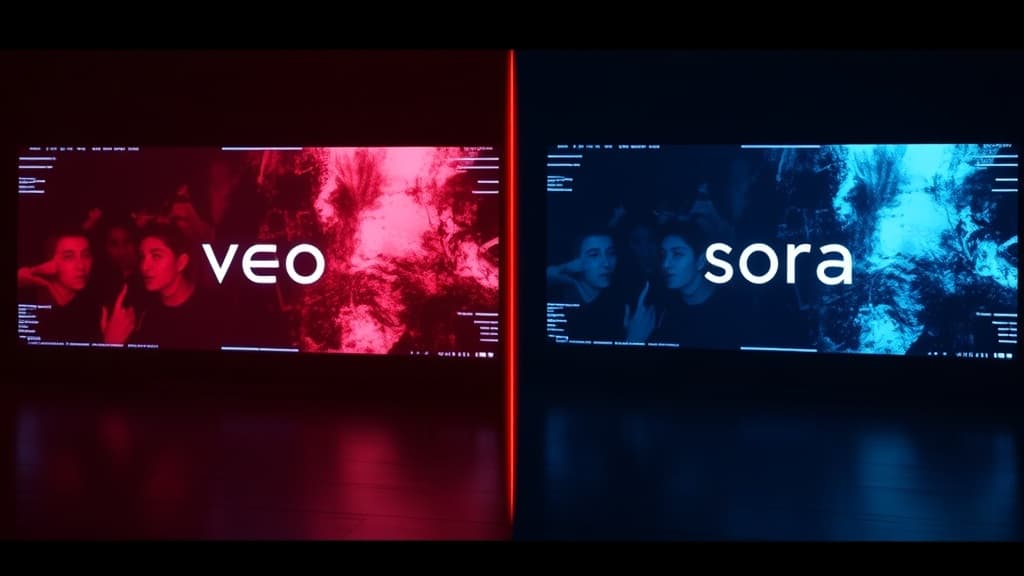
Veo 3 vs Sora: The Two Giants of AI Video, Compared
Google and OpenAI are fighting over the future of AI video generation, and the rest of us get to benefit. Veo 3 and Sora are, by most accounts, the two most capable text-to-video models in the world right now. But they're very different products with very different access models.
If you're trying to decide between them — or figure out how to actually use either one — here's the honest breakdown.
Quick Background
Sora was announced by OpenAI in February 2024 with a jaw-dropping demo reel. It then... didn't launch for almost a year. When it finally became available in late 2024, it was bundled into ChatGPT Plus and Pro subscriptions. The gap between the demo hype and the actual product release gave competitors time to catch up.
Veo 3 is Google DeepMind's third-generation video model, released in late 2025. It was less hyped than Sora but arguably more impactful on arrival because it shipped with native audio generation — your video clips come with synchronized sound effects, ambient audio, and even dialogue.
Output Quality
This is what everyone wants to know, so let's get to it.
Motion realism: Veo 3 has the edge. Human movement, animal locomotion, fluid dynamics — things that look "right" to our pattern-matching brains — Veo 3 handles these more consistently. Sora occasionally produces that uncanny quality where everything moves slightly too smoothly, like a video game cutscene from 2030.
Prompt adherence: Roughly equal. Both models understand complex scene descriptions well. If you ask for "a woman in a red dress walking through a crowded Tokyo street at night with neon reflections on wet pavement," both will deliver something close to that. Sora might be slightly better at handling very long, detailed prompts.
Consistency: Sora is better at maintaining character appearance across a clip. If a person turns their head, their face stays the same face. Veo 3 occasionally shifts facial features during movement, though this has improved dramatically from Veo 2.
Audio: Veo 3 wins by default — it generates synchronized audio natively. Footsteps match walking, ambient city noise matches street scenes, and dialogue is lip-synced (though the voice quality is more "functional" than "cinematic"). Sora generates silent video. You need to add audio separately.
Resolution: Both output up to 1080p for standard generations. Veo 3 can push to 4K through Google's API but it's slow and expensive. Sora maxes at 1080p through ChatGPT.
Access and Pricing
This is where the comparison gets frustrating, because neither model makes it simple.
Sora Access
Sora is bundled into ChatGPT subscriptions:
- ChatGPT Plus ($20/month): Includes Sora access with limits. You get roughly 50 video generations per month (the exact number isn't published and seems to fluctuate). Priority is lower than Pro subscribers, so generation times are longer during peak hours.
- ChatGPT Pro ($200/month): Higher limits, faster generation, priority queue. If you're generating a lot of video, this is the tier OpenAI wants you on.
There's no standalone Sora product. You can't pay $5 to generate 10 clips. It's subscription-only, bundled with everything else ChatGPT does.
Cost per clip: On Plus, assuming 50 clips/month, that's $0.40 per clip. On Pro, if you generate 200 clips/month, that's $1.00 per clip — but you're also paying for unlimited GPT-4o, DALL-E, and everything else.
Veo 3 Access
Google offers Veo 3 through a few channels:
- Google AI Studio / Vertex AI: Direct API access. Pay per generation. Pricing varies but runs roughly $0.05-$0.10 per second of video. A 10-second clip costs $0.50-$1.00. Requires a Google Cloud account and some technical setup.
- Third-party platforms: Several platforms have integrated Veo 3 through Google's API. Myjourney offers Veo 3 at $0.50 per video clip with no subscription required.
Cost per clip: $0.50 on Myjourney. No monthly commitment. Generate one clip or a hundred — same price each.
Pricing Verdict
If you're already paying for ChatGPT Pro for other reasons, Sora is "free" on top. If you're evaluating video generation on its own, Veo 3 through a pay-per-use platform is more predictable and often cheaper.
For someone who needs 20 video clips for a project and doesn't want a subscription: Veo 3 on Myjourney costs $10 total. Sora requires a $20/month ChatGPT Plus subscription minimum.
Speed
Sora: 30-90 seconds per clip on Plus, 15-45 seconds on Pro. During peak hours, Plus users sometimes wait 2-3 minutes.
Veo 3: 2-4 minutes per clip. Consistently slower than Sora. The audio generation adds processing time.
If speed matters for your workflow, Sora is noticeably faster. If you're generating a handful of clips and can wait a few minutes, the speed difference isn't a dealbreaker.
What Each One Does Better
Veo 3 wins at:
- Realistic motion and physics
- Native audio generation (huge time saver)
- Complex multi-person scenes
- Environmental detail (weather, lighting, reflections)
- Pay-per-use accessibility
Sora wins at:
- Character consistency across clips
- Generation speed
- Long prompt comprehension
- Integration with the ChatGPT ecosystem
- Iterative refinement through conversation ("make it more dramatic")
Use Cases
Short social content (TikTok, Reels, Shorts): Either works. Sora's speed advantage helps if you're iterating quickly. Veo 3's native audio saves you from sourcing sound effects.
Product demos and explainers: Veo 3's physics realism makes product shots more convincing. If you're showing a physical product in a scene, Veo 3 renders materials and lighting more accurately.
Creative/artistic projects: Sora's conversational interface (through ChatGPT) makes it easier to refine your vision iteratively. "Make the lighting warmer." "Add rain." This workflow doesn't exist with Veo 3's API-based access.
One-off projects: Veo 3 through Myjourney at $0.50/clip. No subscription to manage, no cancellation to remember.
The Honest Take
Both models are extraordinary compared to what existed 18 months ago. The differences between them are real but smaller than the gap between either of them and everything else (Runway, Pika, etc. — though those tools have their own strengths, particularly in controllability).
If we had to pick one for pure output quality today, it's Veo 3. The native audio, the motion realism, and the pay-per-use availability through platforms like Myjourney make it the more practical choice for most people.
But if you're already in the OpenAI ecosystem and want video as part of a larger creative workflow with GPT-4o, Sora is genuinely good and gets better with each update.
Check the Explore gallery to see Veo 3 outputs from real users — every clip shows the prompt used, so you can judge quality and plan your own projects before spending a cent.
Ready to try it yourself?
Create AI images and videos with Myjourney. 100 free credits, no credit card needed.
Related posts

How to Generate AI Videos from Text in 2026
A practical, no fluff guide to turning prompts into video using Veo 3, Runway, Pika, Kling, and Sora. Includes step by step workflow.
Liked this post?
Get notified when we publish new guides, tips, and comparisons. No spam.